
Skip to main content Accessibility help
×
  • Cited by 34
    • The digital format of this book is no longer available to purchase from Cambridge Core. Other formats may be available.
    • This product has been replaced by an open access version available under ISBN 9781009281621
    • Show more authors
    • You may already have access via personal or institutional login
    • Select format
    • Publisher:
      Cambridge University Press
      Publication date:
      Invalid date
      September 2021
      ISBN:
      Dimensions:
      Weight & Pages:
      Dimensions:
      Weight & Pages:
    You may already have access via personal or institutional login
    Selected: Paperback
    View cart Buy from Cambridge.org

    Book description

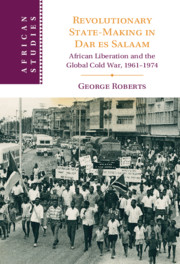
    Tracing Dar es Salaam's rise and fall as an epicentre of Third World revolution, George Roberts explores the connections between the global Cold War, African liberation struggles, and Tanzania's efforts to build a socialist state. Instead of understanding decolonisation through a national lens, he locates the intersection of these dynamics in a globally-connected city in East Africa. Revolutionary State-Making in Dar es Salaam introduces a vibrant cast of politicians, guerrilla leaders, diplomats, journalists, and intellectuals whose trajectories collided in the city. In its cosmopolitan and rumour-filled hotel bars, embassy receptions, and newspaper offices, they grappled with challenges of remaking a world after empire. Yet Dar es Salaam's role on the frontline of the African revolution and its provocative stance towards global geopolitics came at considerable cost. Roberts explains how Tanzania's strident anti-imperialism ultimately drove an authoritarian turn in its socialist project and tighter control over the city's public sphere.

    Reviews

    ‘In the 1960s, the itineraries of Cold War strategists, anti-colonial freedom fighters, and Pan-Africanists from all over the world crisscrossed through the cosmopolitan metropolis of Dar es Salaam. This exciting and original book reveals how Cold War Dar es Salaam emerged as a vibrant global hub where thinkers, strategists and freedom fighters gathered to create their visions of a postcolonial world order. Roberts reveals the profound challenges of non-alignment in a world riven by Cold War struggles.’

    Emily Callaci - University of Wisconsin, Madison

    ‘Roberts puts Dar es Salaam in its rightful place in the political historiography of liberation in Southern Africa in particular and the Global South in general. At a time when xenophobia and parochial nationalism are on the rise, Roberts reminds readers of the strategic role of this ‘revolutionary city’ and its Nkrumah Street in forging Pan-Africanism and ‘Third World’ solidarity during the ‘global sixties’. The book is a gem to those interested in Cold War politics, state-building, capitalism, socialism, urbanism, globalization, and transnationalism.’

    Chambi Chachage - Princeton University

    ‘A deeply researched and carefully woven book. Focusing on the city of Dar es Salaam in the decade after independence, it offers a fresh and original account of Tanzania’s post-colonial political history and is an exciting contribution to histories of anti-colonial liberation and the Global Cold War.'

    Emma Hunter - University of Edinburgh

    Refine List

    Actions for selected content:

    Select all | Deselect all
    • View selected items
    • Export citations
    • Download PDF (zip)
    • Save to Kindle
    • Save to Dropbox
    • Save to Google Drive

    Save Search

    You can save your searches here and later view and run them again in "My saved searches".

    Please provide a title, maximum of 40 characters.
    ×

    Contents

    Metrics

    Altmetric attention score

    Full text views

    Total number of HTML views: 0
    Total number of PDF views: 0 *
    Loading metrics...

    Book summary page views

    Total views: 0 *
    Loading metrics...

    * Views captured on Cambridge Core between #date#. This data will be updated every 24 hours.

    Usage data cannot currently be displayed.

    Accessibility standard: Unknown

    Why this information is here

    This section outlines the accessibility features of this content - including support for screen readers, full keyboard navigation and high-contrast display options. This may not be relevant for you.

    Accessibility Information

    Accessibility compliance for the PDF of this book is currently unknown and may be updated in the future.
