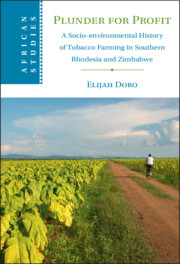

Exploring over a century of Zimbabwe's colonial and post-colonial history, Elijah Doro investigates the murky and noxious history of that powerful crop: tobacco. In a compelling narrative that debunks previous histories glorifying tobacco farming, Doro reveals the indelible marks that tobacco left on landscapes, communities, and people. Demonstrating that the history of tobacco farming is inseparable from that of colonial encounter, Doro outlines how tobacco became an institutionalised culture of production, which was linked to state power and natural ecosystems, and driven by a pernicious heritage of unbridled plunder. With the destruction of landscapes, the negative impacts of the export trade and the growing tobacco epidemic in Zimbabwe, tobacco farming has a long and varied legacy in southern African and across the world. Connecting the local to the global, and the environmental to the social, this book illuminates our understandings of environmental history, colonialism and sustainability.
‘Motivated by his childhood experiences growing tobacco, Elijah Doro carefully reconstructs the history of tobacco cultivation in Southern Rhodesia and Zimbabwe. The history of the cigarette is an African history and, as Doro deftly shows, it is one that cannot be understood apart from the land, labor, and aspirations of Zimbabweans who have staked their futures-wittingly and unwittingly-on the ‘golden crop'.'
Sarah Milov - University of Virginia
‘Elijah Doro shows us how important historians can be in understanding the slow violence of the Anthropocene. However, he also shows how ordinary men and women survived this new world. This book brings old historiographies into new conversations and is one of the best examples yet of combining political economy and environmental history.'
Sandra Swart - Stellenbosch University
‘I think this important book has at least three merits: it refines and integrates existing historiographies, it resists teleological accounts of environmental history, and it combines all this with a passionate civic engagement.’
Giovanni Tonolo Source: Environment and History
‘Doro has written a nuanced history of tobacco in Zimbabwe, one that emphasizes how a socioenvironmental perspective can illuminate the shifting relationships between commodities, ecology, health, medical research, race, and politics. Advanced undergraduates, graduate students, and historians of Africa, environment, agriculture, colonialism, and public health will learn much from this book.’
Christopher R. Conz Source: American Historical Review
Loading metrics...
* Views captured on Cambridge Core between #date#. This data will be updated every 24 hours.
Usage data cannot currently be displayed.
This section outlines the accessibility features of this content - including support for screen readers, full keyboard navigation and high-contrast display options. This may not be relevant for you.
Accessibility compliance for the PDF of this book is currently unknown and may be updated in the future.
