
Skip to main content Accessibility help
×
  • Cited by 24
    • Show more authors
    • You may already have access via personal or institutional login
    • Select format
    • Publisher:
      Cambridge University Press
      Publication date:
      December 2013
      January 2014
      ISBN:
      9781139026987
      9780521196987
      9781107595750
      Dimensions:
      (228 x 152 mm)
      Weight & Pages:
      0.57kg, 304 Pages
      Dimensions:
      (229 x 152 mm)
      Weight & Pages:
      0.46kg, 308 Pages
    You may already have access via personal or institutional login
  • Selected: Digital
    Add to cart View cart Buy from Cambridge.org

    Book description

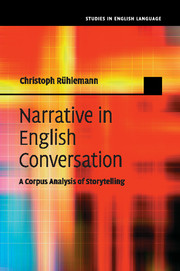
    Storytelling is a fundamental mode of everyday interaction. This book is based upon the Narrative Corpus (NC), a specialized corpus of naturally occurring narratives, and provides new paths for its study. Christoph Rühlemann uses the NC's narrative-specific annotation and XPath and XQuery, query languages that allow the retrieval of complex data structures, to facilitate large-scale quantitative investigations into how narrators and recipients collaborate in storytelling. Empirical analyses are validated using R, a programming language and environment for statistical computing and graphics. Using this unique data and methodological base, Rühlemann reveals new insights, including the discovery of turntaking patterns specific to narrative, the first investigation of textual colligation in spoken data, the unearthing of how speech reports, as discourse units, form striking patterns at utterance level, and the identification of the story climax as the sequential context in which recipient dialogue is preferentially positioned.

    Reviews

    ‘Rühlemann's book is a rare gem in the study of conversational narrative. It is based on a corpus specifically compiled for this study, breaks new ground with sophisticated computational and statistical tools, and is full of astute observations and qualitative interpretation. No scholar of narratives will want to miss this.'

    Stefan Th. Gries - University of California, Santa Barbara

    ‘This book offers an excellent example of how to do significant original work on conversational narrative through the inventive development and use of corpus data. It demonstrates how sophisticated computer methods combine with intelligent hypothesis formulation to yield significant insights on conversational storytelling as an interactional achievement.'

    Neal Norrick - Saarland University

    ‘Rühlemann's work brings together in a timely fashion the best of discourse analysis and corpus linguistics. Exploiting the explanatory power of a large, carefully annotated specialised corpus, it breaks new ground in spoken corpus analysis by uncovering the delicate interweaving of speakers and listeners as they jointly construct their worlds.'

    Mike McCarthy - University of Nottingham

    Refine List

    Actions for selected content:

    Select all | Deselect all
    • View selected items
    • Export citations
    • Download PDF (zip)
    • Save to Kindle
    • Save to Dropbox
    • Save to Google Drive

    Save Search

    You can save your searches here and later view and run them again in "My saved searches".

    Please provide a title, maximum of 40 characters.
    ×

    Contents

    References

    Aijmer, K. 1987. “Oh and Ah in English conversation,” in W. Meijs (ed.) Corpus linguistics and beyond. Amsterdam/Atlanta, GA: Rodopi, pp. 61–86
    Aijmer, K. 1996. Conversational routines in English. London: Longman
    Aikhenvald, A. Y. 2004. Evidentiality. Cambridge University Press
    Allwood, J., J. Nivre, and E. Ahlsén. 1990. “Speech management: On the non-written life of speech,” Nordic Journal of Linguistics 13: 3–48
    Ameka, F. 1992. “Interjections: The universal yet neglected part of speech,” Journal of Pragmatics 18: 101–118
    Andersen, G. 2001. Pragmatic markers and sociolinguistic variation. Amsterdam: John Benjamins
    Anderson, R. C. 1977. “The notion of schemata and the educational enterprise,” in R. C. Anderson, R. J. Sapiro and W. E. Montague (eds.) Schooling and the acquisition of knowledge. Hillsdale, NJ: Lawrence Erlbaum, pp. 415–431
    Aston, G. and L. Burnard. 1998. The BNC handbook. Exploring the British National Corpus with SARA. Edinburgh University Press
    Baayen, H. 2008. Analyzing linguistic data: A practical introduction to statistics using R. Cambridge University Press
    Baker, P. 2006. Using corpora in discourse analysis. London/New York: Continuum
    Bamberg, M. 2004a. “Form and function of ‘slut bashing’ in male identity constructions in 15-year-olds,” Human Development 47: 331–353
    Bamberg, M. 2004b. “Talk, small stories, and adolescent identities,” Human Development 47: 366–369
    Banfield, A. 1973. “Narrative style and the grammar of direct and indirect speech,” Foundations of Language 10(1): 1–39
    Bangerter, A., E. Mayor, and S. Pekarek Doehler. 2011. “Reported speech in conversational storytelling during nursing shift handover meetings,” Discourse Processes 48: 183–214
    Barbieri, F. 2007. “Older men and younger women. A corpus-based study of quotative use in American English,” English World-Wide 28(1): 23–45
    Barlow, M. 2011. “Corpus linguistics and theoretical linguistics,” International Journal of Corpus Linguistics 16(1): 3–44
    Barthes, R. 1974. “An introduction to the structural analysis of narrative,” New Literary History 6(2):237–272
    Bartlett, F. C. 1932. Remembering: A study in experimental and social psychology. Cambridge University Press
    Baynham, M. 1996. “Direct speech: What’s it doing in non-narrative discourse?,” Journal of Pragmatics 25: 61–81
    Benjamini, Y. 1988. “Opening the box of a boxplot,” The American Statistician 42(4): 257–262
    Besnier, N. 1994. “Involvement in linguistic practice: an ethnographic appraisal,” Journal of Pragmatics 22: 279–299
    Biber, D. and S. Conrad. 1999. “Lexical bundles in conversation and academic prose,” in H. Hasselgard and S. Oksefjell (eds.) Out of corpora. Studies in honour of Stig Johansson. Amsterdam/Atlanta, GA: Rodopi, pp. 181–190
    Biber, D. and S. Conrad. 2001. “Quantitative corpus-based research: More than bean counting,” TESOL Quarterly 35(2): 331–336
    Biber, D. and J. K. Jones. 2005. “Merging corpus linguistic and discourse analytic research goals: Discourse units in biology research articles,” Corpus Linguistics and Linguistic Theory 1(2): 151–182
    Biber, D., S. Johansson, G. Leech, S. Conrad, and E. Finegan. 1999. Longman grammar of spoken and written English. Harlow: Pearson Education Limited
    Bilous, F. R. and R. M. Krauss. 1988. “Dominance and accommodation in the conversational behaviours of same- and mixed-sex dyads,” Language and Communication 8(3–4): 183–194
    Blum-Kulka, S. 1993. “‘You gotta know how to tell a story’: Telling, tales, and tellers in American and Israeli narrative events at dinner,” Language in Society 22(3): 361–402
    Bolden, G. 2004. “The quote and beyond: Defining boundaries of reported speech in conversational Russian,” Journal of Pragmatics 36: 1071–1118
    Brendel, E., J. Meibauer and M. Steinbach. 2011. “Exploring the meaning of quotation,” in E. Brendel, J. Meibauer and M. Steinbach (eds.) Understanding quotation. Berlin: Mouton de Gruyter, pp. 1–33
    Brown, G. and G. Yule. 1983. Discourse analysis. Cambridge University Press
    Brown, P. and S. C. Levinson. 1987. Politeness: Some universals in language use. Cambridge University Press
    Buchstaller, I. 2002. “He goes and I’m like: The new quotatives revisited,” Internet Proceedings of the University of Edinburgh Postgraduate Conference 120. Available at: www.ling.ed.ac.uk/~pgc/archive/2002/proc02/buchstaller02.pdf (last accessed September 2013)
    Buchstaller, I. 2008. “The localization of global linguistic variants,” English World-Wide 29(1): 15–44
    Buchstaller, I. 2011. “Quotations across the generations: A multivariate analysis of speech and thought introducers across 5 decades of Tyneside speech,” Corpus Linguistics and Linguistic Theory 7(1): 59–52
    Bühler, K. 1990 [1934]. Theory of language. The representational function of language. Amsterdam/Philadelphia: John Benjamins
    Butters, R. R. 1982. “Narrative Go ‘Say’,” American Speech 55(4): 304–307
    Caffi, C. and R. W. Janney. 1994. “Towards a pragmatics of emotive communication,” Journal of Pragmatics 22: 325–373
    Carruthers, J. 2008. “Annotating an oral corpus using the Text Encoding Initiative. Methodology, problems, solutions,” Journal of French Language Studies 18: 103–119
    Carter, R. A. and M. J. McCarthy. 1997. Exploring spoken English. Cambridge University Press
    Carter, R. A., and M. J. McCarthy. 2006. Cambridge grammar of English. Cambridge University Press
    Chafe, W. 1987. “Cognitive constraints on information flow,” in R. S. Tomlin (ed.) Coherence and grounding in discourse. Amsterdam/Philadelphia: John Benjamins, pp. 21–51
    Chafe, W. 1992. “The importance of corpus linguistics to understanding the nature of language,” in J. Svartvik (ed.) Directions in corpus linguistics. Proceedings of Nobel Symposium 82, Stockholm, August 4–8, 1991. Berlin: Mouton de Gruyter, pp. 79–97
    Chatman, J. R. 1975. “Towards a theory of narrative,” New Literary History 6(2): 295–318
    Cheng, W., C. Greaves, and M. Warren. 2006. “From ngram to skipgram to concgram,” International Journal of Corpus Linguistics 11(4): 411–433
    Chomsky, N. 1965. Aspects of the theory of syntax. Cambridge, MA: MIT Press
    Clark, H. H. and R. J. Gerrig. 1990. “Quotations as demonstrations,” Language 66(4): 764–805
    Clark, J. and S. DeRose. 1999. “XML Path Language XPath Version 1.0,” available online at www.w3.org/TR/xpath (accessed September 2013)
    Clift, R. 2006. “Indexing stance: Reported speech as an interactional evidential,” Journal of Sociolinguistics 10(5): 569–595
    Clift, R. 2007. “Getting there first: Non-narrative reported speech in interaction,” in E. Holt and R. Clift (eds.) Reporting talk. Reported speech in interaction. Cambridge University Press, pp. 120–149
    Coulmas, F. (ed.) 1986. “Reported speech: Some general issues,” in F. Coulmas (ed.) Direct and indirect speech. Berlin/New York/Amsterdam: Mouton de Gruyter, pp. 1–28
    Coulthard, M. 1977. An introduction to discourse analysis. London: Longman
    Crawley, M. J. 2007. The R book. Chichester: John Wiley
    Crystal, D. 5th edn 2003. A Dictionary of linguistics and phonetics. Oxford: Blackwell Publishing
    Culpeper, J. 2011. Impoliteness: Using language to cause offence. Cambridge University Press
    Daiute, C. and K. Nelson. 1997. “Making sense of the sense-making function of narrative evaluation,” Journal of Narrative Inquiry and Life History 7(1–4): 207–215
    Dalgaard, P. 2nd edn 2008. Introductory statistics with R. Berlin: Springer
    Danescu-Niculescu-Mizil, C. and L. Lillian. 2011. “Chameleons in imagined conversations: A new approach to understanding coordination of linguistic style in dialogs,” Cognitive Modeling and Computational Linguistics Workshop at ACL 2011, available at: www.cs.cornell.edu/~cristian/papers/chameleons.pdf (accessed September 2013)
    Davies, M. 2009. “The 385+ million word Corpus of Contemporary American English (1990–2008+). Design, architecture, and linguistic insights,” International Journal of Corpus Linguistics 14(2): 159–190
    Dijk, T. A. van. 1975. “Action, action description, and narrative,” New Literary History 6(2): 273–294
    Dijk, T. A. van and W. Kintsch. 1983. Strategies of discourse comprehension. New York/London: Academic Press
    Duranti, A. 1986. “The audience as co-author. An introduction,” Text 6(3): 239–247
    Duranti, A. and C. Goodwin (eds.) 1992. Rethinking context: Language as an interactive phenomenon. Cambridge University Press
    Durrant, P. and A. Doherty. 2010. “Are high-frequency collocations psychologically real? Investigating the thesis of collocational priming,” Corpus Linguistics and Linguistic Theory 6(2): 125–155
    Edelsky, C. 1993. “Who’s got the floor?,” in D. Tannen (ed.) Gender and conversational organization. Oxford University Press, pp. 189–227
    Edwards, D. 1997. “Structure and function in the analysis of everyday narratives,” Journal of Narrative and Life History 7(1–4): 207–215
    Efron, B. 1979. “Bootstrap methods: Another look at the jackknife,” The Annals of Statistics 7(1): 1–26, available at: http://projecteuclid.org/DPubS/Repository/1.0/Disseminate?view=bodyandid=pdf_1andhandle=euclid.aos/1176344552
    Ellis, N., E. Frey and I. Jalkanen. 2009. “The psycholinguistic reality of collocation and semantic prosody 1. Lexical access,” in U. Römer and R. Schulze (eds.) Exploring the lexis-grammar interface. Amsterdam/Philadelphia: John Benjamins, pp. 89–113
    Erk, K., S. Padó and U. Padó. 2010. “A flexible, corpus-driven model of regular and inverse selectional preferences,” Computational Linguistics 36(4): 723–763
    Ervin-Tripp, S. M. and A. Küntay. 1997. “The occasioning and structure of conversational stories,” in T. Givón (ed.) Conversation: Cognitive, communicative and social perspectives. Amsterdam/Philadelphia: John Benjamins, pp. 133–166
    Fairon, C. and J. V. Singler. 2006. “I’m like, ‘Hey, it works!’: Using GlossaNet to find attestations of the quotative be like in English-language newspapers,” in A. J. Renouf and A. Kehoe (eds.) The changing face of corpus linguistics. Amsterdam/New York: Rodopi, pp. 325–336
    Ferrara, K. and B. Bell. 1995. “Sociolinguistic variation and discourse function of constructed dialog introducers: The case of be + like,” American Speech 70(3): 265–290
    Firth, J. R. 1968. “A synopsis of linguistic theory,” in F. R. Palmer (ed.) Selected papers of J. R. Firth 1952–1959. Harlow: Longman, pp. 168–205
    Flowerdew, L. 1998. “Corpus linguistic techniques applied to text-linguistics,” System 26: 541–552
    Fox, B. A. and S. A. Thompson. 2010. “Responses to wh-questions in English conversation,” Research on Language and Social Interaction 43(2): 133–156
    Fraser, B. 1990. “An approach to discourse markers,” Journal of Pragmatics 14: 383–395
    Frigge, M., D. C. Hoaglin, and B. Iglewicz. 1989. “Some implementations of the boxplot,” The American Statistician 43(1): 50–54
    Galatolo, R. 2007. “Active voicing court,” in E. Holt and R. Clift (eds.) Reporting talk. Reported speech in interaction. Cambridge University Press, pp. 195–220
    Gardner, R. 1998. “Between speaking and listening: The vocalisation of understandings,” Applied Linguistics 19(2): 204–224
    Garside, R., S. Fligelstone and S. Botley. 1997. “Discourse annotation: anaphoric relations in corpora,” in R. Garside, G. Leech, and T. McEnery (eds.) Corpus annotation. Linguistic information from computer text corpora. London/New York: Longman, pp. 66–84
    Garside, R., G. Leech, and T. McEnery (eds.) 1997. Corpus annotation. Linguistic annotation from computer text corpora. London/New York: Longman
    Georgakopoulou, A. 1997. Narrative performances: A study of Modern Greek storytelling. Amsterdam: John Benjamins
    Georgakopoulou, A. 2006a. “Thinking big with small stories in narrative and identity analysis,” Narrative Inquiry 16(1): 122–130
    Georgakopoulou, A. 2006b. “The other side of the story: towards a narrative analysis of narrative-in-interaction,” Discourse Studies 8(2): 265–287
    Georgakopoulou, A. 2008. “On MNS with buff boys. Self and other-identities in the context of small stories,” Journal of Sociolinguistics 12: 597–626
    Giles, H., J. Coupland, and N. Coupland (eds.) 1991. Contexts of accommodation. Cambridge University Press
    Gilquin, G. 2002. “Automatic retrieval of syntactic structures. The quest for the holy grail,” International Journal of Corpus Linguistics 7(2): 183–214
    Glenn, P. 2003. Laughter in interaction. Cambridge University Press
    Goffman, Ervin. 1981. Forms of talk. Philadelphia University Press
    Golato, A. 2000. “An innovative German quotative for reporting embodied actions: Und ich so/und er so ‘and I’m like/and he’s like’,” Journal of Pragmatics 32: 29–54
    Golato, A. 2002. “Self-quotation in German: Reporting on past decisions,” in T. Güldemann and M. von Roncador (eds.) Reported discourse: A meeting ground for different linguistic domains. Amsterdam: John Benjamins, pp. 49–70
    Goodwin, C. 1979. “The interactive construction of a sentence in natural conversation,” in G. Psathas (ed.) Everyday language – Studies in ethnomethodology. New York: Irvington Publishers, pp. 97–121
    Goodwin, C. 1986a. “Between and within alternative sequential treatments of continuers and assessments,” Human Studies 9, 205–217
    Goodwin, C. 1986b. “Audience diversity, participation and diversity,” Text 6(3): 283–316
    Goodwin, C. 2007. “Interactive footing,” in E. Holt and R. Clift (eds.) Reporting talk. Reported speech in interaction. Cambridge University Press, pp. 16–46
    Goodwin, C. and J. Heritage. 1990. “Conversation analysis,” Annual Review of Anthropology 19: 283–307
    Greene, W. 2008. “Functional forms for the negative binomial model for count data,” Economics Letters 99: 585–590
    Gries, S. Th. 2006. “Exploring variability within and between corpora: some methodological considerations,” Corpora 1(2): 109–151
    Gries, S. Th. 2009a. Quantitative corpus linguistics with R. A practical introduction. New York/London: Routledge
    Gries, S. Th. 2009b. Statistics for linguistics with R. A practical introduction. Berlin: Mouton de Gruyter
    Gwyn, R. 2000. “‘Really unreal’: Narrative evaluation and the objectification of experience,” Narrative Inquiry 10(2): 313–340
    Halliday, M. A. K. 2006. “Afterwords,” in G. Thompson and S. Hunston (eds.) System and corpus: Exploring connections. London/Oakville: Equinox, pp. 293–299
    Halliday, M. A. K. and R. Hasan. 1989. Language, Context, and Text: Aspects of Language in a Social-semiotic Perspective. Oxford University Press
    Halliday, M. A. K. and M. I. M. Matthiessen. 3rd edn. 2004. An Introduction to Functional grammar. London: Edward Arnold
    Hanks, W. F. 1992. “The indexical ground of deictic reference,” in A. Duranti and C. Goodwin (eds.) Rethinking context: Language as an interactive phenomenon. Cambridge University Press, pp. 43–76
    Hanks, W. F. 2011. “Deixis and indexicality,” in W. Bublitz and N. R. Norrick (eds.) Handbook of pragmatics. Vol. 1 Foundations of pragmatics. Berlin: Mouton de Gruyter, pp. 315–346
    Helasvuo, M. 2004. “Shared syntax: the grammar of co-constructions,” Journal of Pragmatics 36: 1315–1336
    Heritage, J. 1998. “Oh-prefaced responses to inquiry,” Language in Society 27: 291–334
    Hoey, M. 1991. Patterns of lexis in text. Cambridge University Press
    Hoey, M. 2005. Lexical priming. A new theory of words and language. London/New York: Routledge
    Hoey, M. and M. B. O’Donnell. 2008. “Lexicography, grammar, and textual position,” International Journal of Lexicography 21(3): 293–309
    Hoey, M. and M. B. O’Donnell. Forthcoming. “Examining associations between lexis and textual position in newspaper discourse or According to a study by. . .,” International Journal of Corpus Linguistics
    Hoffmann, S. and S. Evert. 2007. “Errors and inconsistencies in the XML-version of the BNC,” available at http://bncweb.info (last accessed May 2013)
    Hoffmann, S., S. Evert, N. Smith, D. Lee, and Y. Berglund Prytz, 2008. Corpus linguistics with BNCweb – A practical guide. Frankfurt am Main: Peter Lang
    Holmes, J. 1997a. “Women, language and identity,” Journal of Sociolinguistics 1(2): 195–223
    Holmes, J. 1997b. “Struggling beyond Labov & Waletzky,” Journal of Narrative and Life History 7(1–4): 91–96
    Holmes, J. and M. Stubbe. 1997. “Good listeners: Gender differences in New Zealand conversation”, Women and Language 20(2): 7–14
    Holt, E. 1996. “Reporting talk: The use of direct reported speech in conversation,” Research on Language and Social Interaction 29(3): 219–245
    Holt, E. 2000. “Reporting and reacting: Concurrent responses to reported speech,” Research on language and social interaction 33(4): 425–454
    Holt, E. 2007. “‘I’m eying your chop up mind’: Reporting and enacting,” in E. Holt and R. Clift (eds.) Reporting talk. Reported speech in interaction. Cambridge University Press, pp. 47–80
    Holt, E. and R. Clift (eds.) 2007. Reporting talk. Reported speech in interaction. Cambridge University Press
    Huddleston, R. 1984. Introduction to the grammar of English. Cambridge University Press
    Hundt, M., N. Nesselhauf and C. Biewer (eds.) 2007. Corpus linguistics and the web. Amsterdam/New York: Rodopi
    Hunston, S. 2002. Corpora in applied linguistics. Oxford University Press
    Jakobson, R. 1960. “Linguistics and Poetics,” in T. Sebeok (ed.) Style in Language. Cambridge, MA: MIT Press
    James, A. R. 1983. “‘Well’ in reporting clauses: Meaning and form of a ‘lexical filler’,” Arbeiten aus Anglistik und Amerikanistik 8(1): 33–40
    Jefferson, G. 1978. “Discourse analysis and narrative,” in J. Schenkein (ed.) Studies in the organization of conversational interaction. New York: Academic Press, pp. 219–248
    Johnson, M. and E. Lepore. 2011. “Misrepresenting misrepresentation,” in E. Brendel, J. Meibauer, and M. Steinbach (eds.) Understanding quotation. Berlin: Mouton de Gruyter, pp. 231–249
    Johnstone, B. 1993. “Community and contest: Midwestern men and women creating their worlds in conversational storytelling,” in D. Tannen (ed.), pp. 63–80
    Johnstone, B. 1997. “Social characteristics and self-expression in narrative,” Journal of Narrative and Life History 7(1–4): 315–320
    Jucker, A. H. 1993. “The discourse marker well: A relevance-theoretical account,” Journal of Pragmatics 19(5): 435–452
    Kallen, J. L. and J. Kirk. 2012. SPICE-Ireland: A user’s guide. Belfast: Cló Ollscoil na Banríona
    Kilgarriff, A. and G. Grefenstette. 2003. “Introduction to the Special Issue on the web as corpus,” Computational Linguistics 29 (3): 333–347
    Kjellmer, G. 2003. “Hesitation. In defence of er and erm,” English Studies 84(2): 170–198
    Klewitz, G. and E. Couper-Kuhlen. 1999. “Quote-unquote: the role of prosody in the contextualization of reported speech sequences,” Pragmatics 9(4): 459–485
    Koehn, P. 2004. “Statistical significance tests for machine translation evaluation,” in Proceedings of the Conference on Empirical Methods in Natural Language Processing EMNLP, available at: http://acl.ldc.upenn.edu/acl2004/emnlp/pdf/Koehn.pdf (accessed September 2013)
    Kuo, S. -H. 2001. “Reported speech in Chinese political discourse,” Discourse Studies 3(2): 181–202
    Kwon, I. 2012. “Please confirm what I inferred: On the Korean inferential-evidential marker -napo-,” Journal of Pragmatics 44(8): 958–969
    Labov, W. 1972. Language in the Inner City. Oxford: Basil Blackwell
    Labov, W. 1997. “Some further steps in narrative analysis,” Journal of Narrative Inquiry and Life History 7(1–4): 395–415
    Labov, W. 2006. “Narrative pre-construction,” Narrative Inquiry 16(1): 37–45
    Labov, W. and J. Waletzky. 1967/1997. “Narrative analysis: oral versions of personal experience,” in June Helms (ed.) Essays on the verbal and visual arts. Seattle: University of Washington Press, pp. 12–44, reprinted in Journal of Narrative Inquiry and Life History 7(1–4): 3–38
    Lakoff, G. 1990. Women, fire, and dangerous things. What categories reveal about the mind. The University of Chicago Press
    Leech, G. 1983. Principles of pragmatics. London: Longman
    Leech, G. 1997. “Introducing corpus annotation,” in R. Garside, G. Leech, and T. McEnery (eds.) Corpus annotation. Linguistic information from computer text corpora. London/New York: Longman, pp. 1–18
    Leech, G. 2005. “Adding linguistic annotation,” in M. Wynne (ed.) Developing linguistic corpora. A guide to good practice. Oxford: Oxbow, pp. 17–29
    Leech, G. 2007. “New resources, or just better ones? The holy grail of representativeness,” in M. Hundt, N. Nesselhauf and C. Biewer (eds.) Corpus linguistics and the web. Amsterdam/New York: Rodopi, pp. 133–150
    Leech, G. and R. Fallon. 1992. “Computer corpora – What do they tell us about culture?,” ICAME Journal 16: 29–50
    Leech, G. and M. Short. 1981. Style in fiction. London/New York: Longman
    Leech, G., M. Hundt, C. Mair and N. Smith. 2012. Change in contemporary English. A grammatical study. Cambridge University Press
    Leith, D. 1995. “Tense variation as a performance feature in a Scottish folktale,” Language in Society 24(1): 53–77
    Lerner, G. H. 1991. “On the syntax of sentences-in-progress,” Language in Society 20: 441–58
    Levinson, S. C. 1983. Pragmatics. Cambridge University Press
    Levinson, S. C. 2004. “Deixis,” in L. R. Horn and G. Ward (eds.) The handbook of pragmatics. Malden, MA: Blackwell, pp. 97–121
    Levinson, S. C. 2006. “On the human interactional engine,” in N. Enfield and S. C. Levinson (eds.) Roots of human sociality: Culture, cognition and interaction. Oxford: Berg, pp. 39–69
    Li, C. L. 1986. “Direct and indirect speech: A functional study,” in F. Coulmas (ed.) Direct and indirect speech. Berlin: Mouton de Gruyter, pp. 29–45
    Lijffijt, J., P. Papapetrou, K. Puolamäki and H. Mannila. 2011. “Analyzing word frequencies in large text corpora using inter-arrival times and bootstrapping,” in Proceedings of the European Conference of Machine Learning and Principles and Practices of Knowledge Discovery in Databases ECML-PKDD 2011, available at: http://users.ics.tkk.fi/panagpap/lijffijt_157.pdf
    Longacre, R. E. 1983. The grammar of discourse. New York: Plenum Press
    Lyons, J. 1977. Semantics. Volumes I and II. Cambridge University Press
    Macaulay, R. 1987. “Polyphonic monologues: Quoted direct speech in oral narratives,” IPRA Papers in Pragmatics 1: 1–34
    Macaulay, R. 2001. “You’re like ‘why not?’ The quotative expressions of Glasgow adolescents,” Journal of Sociolinguistics 5(1): 3–21
    Mahlberg, M. and M. B. O’Donnell. 2008. “A fresh view of the structure of hard news stories,” in Proceedings of the 19th European Systemic Functional Linguistics Conference and Workshop. http://scidok.sulb.uni-saarland.de/volltexte/2008/1700
    Mathis, T. and G. Yule. 1994. “Zero quotatives,” Discourse Processes 18(1): 63–76
    Mayes, P. 1990. “Quotation in spoken English,” Studies in Language 14: 325–363
    McCarthy, M. J. 1998. Spoken language and applied linguistics. Cambridge University Press
    McCarthy, M. J. 2003. “Talking back: ‘Small’ interactional response tokens in everyday conversation,” Research on Language and Social Interaction 36(1): 33–63
    McEnery, T. and A. Wilson. 1996. Corpus linguistics. Edinburgh University Press
    McIntyre, D. and B. Walker. 2011. “Discourse presentation in Early Modern English writing. A preliminary corpus-based investigation,” International Journal of Corpus Linguistics 16(1): 101–130
    McIntyre, D., C. Bellard Thomson, J. Heywood, T. McEnery, E. Semino, and M. Short. 2004. “Investigating the presentation of speech, writing and thought in spoken British English: A corpus-based approach,” ICAME Journal 28: 49–76
    Miller, J. and R. Weinert. 1998. Spontaneous spoken language: Syntax and discourse. Oxford: Clarendon Press
    Mindt, D. 2000. An empirical grammar of the English verb system. Berlin: Cornelsen
    Minsky, M. 1975. “A framework for representing knowledge,” in P. H. Winston (ed.) The psychology of computer vision. New York: McGraw-Hill, pp. 211–277
    Mittal, H. V. 2011. R graphs cookbook. Birmingham/Mumbai: PACKT Publishing
    Mooney, C. Z., and R. D. Duval. 1993. Bootstrapping. A nonparametric approach to statistical inference. Newbury Park, CA: Sage Publications
    Morley, J. and A. Partington. 2009. “A few Frequently Asked Questions about semantic – or evaluative – prosody,” International Journal of Corpus Linguistics 14(2): 139–158
    Nelson, G., S. Wallis, and B. Aarts. 2002. Exploring natural language: Working with the British component of the International Corpus of English. Amsterdam/Philadelphia: John Benjamins
    Norrick, N. R. 1994. “Involvement and joking in conversation,” Journal of Pragmatics 22: 409–430
    Norrick, N. R. 2000. Conversational narrative. Storytelling in everyday talk. Amsterdam/Philadelphia: John Benjamins
    Norrick, N. R. 2005a. “The dark side of tellability,” Narrative Inquiry 15(2): 323–343
    Norrick, N. R. 2005b. “Interactional remembering in conversational narrative,” Journal of Pragmatics 37: 1819–1844
    Norrick, N. R. 2008a. “Negotiating the reception of stories in conversation. Teller strategies for modulating response,” Narrative Inquiry 18(1): 131–151
    Norrick, N. R. 2008b. “Using large corpora of conversation to investigate narrative: The case of interjections in conversational storytelling performance,” International Journal of Corpus Linguistics 13(4): 465–490
    Norrick, N. R. 2009. “Interjections as pragmatic markers,” Journal of Pragmatics 41: 866–891
    Norrick, N. R. 2010. “Incorporating recipient evaluations into stories,” Narrative Inquiry 20(1): 182–203
    Norrick, N. R. 2011. “Conversational recipe telling,” Journal of Pragmatics 43: 2740–2761
    Norrick, N. R. 2012. “Listening practices in English conversation: The responses responses elicit,” Journal of Pragmatics 44: 566–576
    Norrick, N. R. Forthcoming. “Interjections,” in K. Aijmer and C. Rühlemann (eds.) The Cambridge handbook of corpus pragmatics. Cambridge University Press
    Ochs, E. and L. Capps. 2001. Living narrative. Cambridge, MA: Harvard University Press
    O’Donnell, M. B., M. Scott, M. Mahlberg and M. Hoey. 2012. “Exploring text-initial words, clusters and concgrams in a newspaper corpus,” Special issue of Corpus Linguistics and Linguistic Theory 8(1): 73–101
    O’Keeffe, A. and S. Adolphs. 2008. “Response tokens in British and Irish discourse. Corpus, context and variational pragmatics,” in K. P. Schneider and A. Barron (eds.) Variational pragmatics. Amsterdam: John Benjamins, 69–98
    O’Keeffe, A. and S. Walsh. 2012. “Applying corpus linguistics and conversation analysis in the investigation of small group teaching in higher education,” Corpus Linguistics and Linguistic Theory 8(1): 159–181
    Ono, T. and S. A. Thompson. 1996. “Interaction and syntax in the structure of conversational discourse: Collaboration, overlap, and syntactic dissociation,” in E. H. Hovy and D. R. Scott (eds.) Computational and conversational discourse. Burning issues – An interdisciplinary account. Berlin: Springer, pp. 67–96
    Pang, K. S. 2010. “Eponymy and life-narratives: The effect of foregrounding on proper names,” Journal of Pragmatics 42(5): 1321–1349
    Partington, A. 2004. “‘Utterly content in each other’s company’: Semantic prosody and semantic preference,” International Journal of Corpus Linguistics 9(1): 131–156
    Peters, P. and D. Wong. Forthcoming. “Backchannels and turn management,” in K. Aijmer and C. Rühlemann (eds.) The Cambridge handbook of corpus pragmatics. Cambridge University Press
    Propp, V. 1928/1968. The morphology of the folktale. Austin: University of Texas Press
    Quirk, R., S. Greenbaum, G. Leech and J. Svartvik. 1985. A comprehensive grammar of the English language. London: Longman
    Rayson, P. 2008. “From key words to key semantic domains,” International Journal of Corpus Linguistics 13(4): 519–549
    Rayson, P., G. Leech and M. Hodges. 1997. “Social differentiation in the use of English vocabulary: Some analyses of the conversational component of the British National Corpus,” International Journal of Corpus Linguistics 2(1): 133–152
    R Development Core Team. 2010. R: A language and environment for statistical computing. R Foundation for Statistical Computing, Vienna, Austria. ISBN 3–900051–07–0, URL www.R-project.org
    Redeker, Gisela. 1991. “Linguistic markers of discourse structure,” Linguistics 29: 1139–1172
    Romaine, S. and D. Lange. 1991. “The use of like as a marker of reported speech and thought: a case of ongoing grammaticalization in progress,” American Speech 66(3): 227–279
    Römer, U. and M. B. O’Donnell (2010). “Positional variation of n-grams and phrase-frames in a new corpus of proficient student writing,” paper read at the 31st ICAME conference, May 26–30, 2010, Giessen, Germany
    Rühlemann, C. 2007. Conversation in context: A corpus-driven approach. London: Continuum
    Rühlemann, C. and S. Th. Gries. Forthcoming. “Turn trigrams: Using turntaking patterns as a means for automatic identification of narratives in conversation”.
    Rühlemann, C. and M. B. O’Donnell. 2012. “Introducing a corpus of conversational narratives. Construction and annotation of the Narrative Corpus,” Corpus Linguistics and Linguistic Theory 8 (2): 313–350
    Rühlemann, C. and M. B. O’Donnell. Forthcoming. “Deixis,” in K. Aijmer and C. Rühlemann (eds.) The Cambridge handbook of corpus pragmatics. Cambridge University Press
    Rühlemann, C., A. Bagoutdinov, and M. B. O’Donnell. 2011. “Windows on the mind: Pauses in conversational narrative,” International Journal of Corpus Linguistics 16 (2): 198–230
    Rumelhart, D. 1975. “Notes on a schema for stories,” in D. Bobrow and A. Collins (eds.) Representation and understanding: Studies in cognitive science. New York: Academic Press
    Ryave, A. L. 1978. “On the achievement of a series of stories,” in J. Schenkein (ed.) Studies in the organization of conversational interaction. New York: Academic Press, pp. 113–132
    Sacks, H. 1978. “Some technical considerations of a dirty joke,” in J. Schenkein (ed.) Studies in the organization of conversational interaction. New York: Academic Press, pp. 249–275
    Sacks, H. 1992. Lectures on conversation. Vols. I and II. Oxford: Blackwell
    Sacks, H., E. A. Schegloff, and G. Jefferson. 1974. “A simplest systematics for the organization of turn-taking for conversation,” Language 50(4): 696–735
    Schegloff, E. A. 1972. “Sequencing in conversational openings,” in J. J. Gumperz and D. H. Hymes (eds.) Directions in sociolinguistics. New York: Holt, Rinehart and Winston, pp. 346–380
    Schegloff, E. A 1979. “The relevance of repair for syntax-in-conversation,” in T. Givón (ed.) Discourse and syntax. New York: Academic Press, pp. 261–286
    Schegloff, E. A 1982. “Discourse as an interactional achievement: Some uses of ‘uh huh’ and other things that come between sentences,” in D. Tannen (ed.) Georgetown University round table on languages and linguistics analyzing discourse: Text and talk. Washington DC: Georgetown University Press, pp. 71–93
    Schegloff, E. A 1996. “Turn organization: One intersection of grammar and interaction,” in E. Ochs, E. A. Schegloff, and S. A. Thompson (eds.) Interaction and grammar. Cambridge University Press, pp. 53–133
    Schegloff, E. A 1997. “‘Narrative Analysis’ thirty years later,” Journal of Narrative Inquiry and Life History 7(1–4): 97–106
    Schegloff, E. A. and G. H. Lerner. 2009. “Beginning to respond: Well-prefaced responses to wh-questions,” Research on Language and Social Interaction 42(2): 91–115
    Schiffrin, D. 1984. “How a story says what it means and does,” Text 4(4): 313–346
    Schiffrin, D. 1985. “Conversational coherence: the role of well,” Language 61: 640–667
    Schiffrin, D. 1987. Discourse markers. Cambridge University Press
    Schiffrin, D. 1996. “Narrative as selfportrait: Sociolinguistic construction of identity,” Language in Society 25(1): 167–203
    Schmid, H. -J. and H. Küchenhoff. 2008. “Investigating style. Lexico-grammatical corpus evidence for the socio-situational construction of discourse identities,” paper read at the First Conference of the International Society of the Linguistics of English (ISLE), Freiburg, Germany
    Scott, M. 1997. “PC analysis of key words – and key key words,” System 25(2): 233–245
    Scott, M. 2010. WordSmith Tools version 5. Liverpool: Lexical Analysis Software
    Scott, M. and C. Tribble. 2006. Textual patterns. Key words and corpus analysis in language education. Amsterdam/New York: John Benjamins
    Searle, J. R. 1975. “The logical status of fictional discourse,” New Literary History 6(2): 320–332
    Selting, M. 2000. “The construction of units in conversational talk,” Language in Society 29(4): 477–517
    Semino, E. and M. Short. 2004. Corpus stylistics: Speech, writing and thought presentation in a corpus of English writing. London: Routledge
    Shanon, B. and R. Eiferman. 1984. “Dream reporting discourse,” Text 4(4): 369–379
    Short, M. 2007. “Thought presentation 25 years on,” Style 41(2): 227–257
    Short, M., E. Semino, and J. Culpeper. 1996. “Using a corpus for stylistics research: speech and thought presentation,” in J. Thomas and M. Short (eds.) Using corpora for language research. Studies in honour of Geoffrey Leech. London/New York: Longman, pp. 110–131
    Sinclair, J. McH. 1991. Corpus, concordance, collocation. Oxford University Press
    Sperber, D. and D. Wilson. 1986. Relevance: Communication and cognition. Oxford: Blackwell.
    Stefanowitsch, A. 2005. “New York, Dayton, Ohio, and the raw frequency fallacy,” Corpus Linguistics and Linguistic Theory 1(2): 295–301
    Stefanowitsch, A. and S. Th. Gries. 2003. “Collostructions. Investigating the interaction between words and constructions,” International Journal of Corpus Linguistics 8(2): 209–243
    Stenström, A. -B. 1990. “Pauses in monologue and dialogue,” in J. Svartvik (ed.) The London-Lund Corpus of Spoken English. Lund University Press, pp. 211–252
    Stenström, A. -B., G. Andersen and I. K. Hasund. 2002. Trends in teenage talk. Amsterdam/Philadelphia: John Benjamins
    Stenström, A. and J. Svartvik. 1994. “Imparsable speech: Repeats and other nonfluencies in spoken English,” in N. Oostdijk, N. and P. de Hahn (eds.) Corpus-based research into language. In honour of Jan Aarts. Amsterdam/Atlanta, GA: Rodopi, 241–254
    Stivers, T. and F. Rossano. 2010. “Mobilizing response,” Research on Language and Social Interaction 43(1): 3–31
    Stubbs, M. 2002. Words and phrases. Corpus studies of lexical semantics. Oxford: Blackwell
    Svartvik, J. 1980. “Well in conversation,” in S. Greenbaum, G. Leech, and J. Svartvik (eds.) Studies in English linguistics. For Randolph Quirk. London/New York: Longman, pp. 167–177
    Swales, J. M. 1990. Genre analysis. English in academic and research settings. Cambridge University Press
    Tagliamonte, S. and A. D’Arcy. 2004He’s like, she’s like: The quotative system in Canadian youth,” Journal of Sociolinguistics 8(4): 493–514
    Tagliamonte, S. and R. Hudson. 1999Be like et al. beyond America: The quotative system in British and Canadian youth,” Journal of Sociolinguistics 3(2): 147–172
    Tannen, D. 1978. “The effect of expectations on conversation,” Discourse Processes 1: 203–209
    Tannen, D. 1986. “Introducing constructed dialog in Greek and American conversational and literary narrative,” in F. Coulmas (ed.) Direct and indirect speech. Berlin/New York/Amsterdam: Mouton de Gruyter, pp. 311–332
    Tannen, D. 1988. “Hearing voices in conversation, fiction and mixed genres,” in D. Tannen (ed.) Linguistics in context: Connecting observation and understanding. Norwood, NJ: Ablex, pp. 89–113
    Tannen, D. 1989. Talking voices: Repetition, dialogue, and imagery in conversational discourse. Cambridge University Press
    Tannen, D. 1990. You just don’t understand. New York: William Morrow
    Tannen, D. (ed.) 1993. Gender and conversational interaction. New York/Oxford: Oxford University Press
    Tao, H. (2003). “Turn initiators in spoken English: A corpus-based approach to interaction and grammar,” in P. Leistyna and C. F. Meyer (eds.) Corpus analysis: Language structure and language use. Amsterdam: Rodopi, pp. 187–207
    Thorndyke, P. W. 1977. “Cognitive structures in comprehension and memory of narrative discourse,” Cognitive Psychology 9: 77–110
    Tognini Bonelli, E. 2010. “The evolution of corpus linguistics,” in A. O’Keeffe and M. McCarthy (eds.) The Routledge handbook of corpus linguistics, London/New York: Routledge, pp. 14–27
    Toolan, M. 2nd edn 2001. Narrative. A critical linguistic introduction. Oxford/New York: Routledge
    Upton, Th.A. and U. Connor. 2001. “Using computerized corpus analysis to investigate the textlinguistic discourse moves of a genre,” English for Specific Purposes 20: 313–329
    Wade, E. and H. H. Clark. 1993. “Reproduction and demonstration in quotations,” Journal of Memory and Language, 32(6), 805–819
    Walmsley, P. 2007. XQuery. Sebastopol, CA: O’Reilly
    Walton, M. D. and C. L. Brewer. 2001. “The role of personal narrative in bringing children into the moral discourse of their culture,” Narrative Inquiry 11(2): 307–334
    Watt, A. 2002. XPath essentials. New York: John Wiley
    Weisser, M. 2010. Annotating dialog corpora semi-automatically: A corpus-linguistic approach to pragmatics. Unpublished professorial thesis, University of Bayreuth
    Weisser, M. Forthcoming. “Speech act annotation,” in K. Aijmer and C. Rühlemann (eds.) The Cambridge handbook of corpus pragmatics. Cambridge University Press
    White, S. 1989. “Backchannels across cultures: A study of Americans and Japanese,” Language in Society 18(1): 59–76
    Widdowson, Henry G. 1979. Explorations in applied linguistics. Oxford University Press
    Winter, J. 2002. “Discourse quotatives in Australian English: Adolescents performing voices,” Australian Journal of Linguistics 22(1): 5–21
    Wong, D. 2008. “A corpus based analysis of the pragmatic dimensions of backchannels in Australian English telephone conversations.” Paper read at the 29th ICAME conference, May 14–18, 2008, Ascona, Switzerland
    Wong, D. and P. Peters. 2007. “A study of backchannels in regional varieties of English, using corpus markup as the means of identification,” International Journal of Corpus Linguistics 12(4): 479–509
    Woods, A., P. Fletcher, and A. Hughes. 1986. Statistics in language studies. Cambridge University Press
    Wooffitt, R. 2007. “The dead in the service of the living,” in E. Holt and R. Clift (eds.) Reporting talk. Reported speech in interaction. Cambridge University Press, pp. 244–269
    Wynne, M. (ed.) 2005. Developing linguistic corpora. A guide to good practice. Oxford: Oxbow
    Youmans, G. 1990. “Measuring lexical style and competence: The type-token vocabulary curve,” Style 24: 584–599
    Youmans, G. 1991. “A new tool for discourse analysis: The vocabulary management profile,” Language 67(4): 763–789
    Yule, G. 1996. Pragmatics. Oxford University Press
    Yule, G. and T. Mathis. 1992. “The role of staging and constructed dialog in establishing speaker’s topic,” Linguistics 3: 199–215

    Metrics

    Altmetric attention score

    Full text views

    Total number of HTML views: 0
    Total number of PDF views: 0 *
    Loading metrics...

    Book summary page views

    Total views: 0 *
    Loading metrics...

    * Views captured on Cambridge Core between #date#. This data will be updated every 24 hours.

    Usage data cannot currently be displayed.

    Accessibility standard: Unknown

    Why this information is here

    This section outlines the accessibility features of this content - including support for screen readers, full keyboard navigation and high-contrast display options. This may not be relevant for you.

    Accessibility Information

    Accessibility compliance for the PDF of this book is currently unknown and may be updated in the future.
