
Skip to main content Accessibility help
×
  • Cited by 2
    • Show more authors
    • You may already have access via personal or institutional login
    • Select format
    • Publisher:
      Cambridge University Press
      Publication date:
      October 2025
      August 2025
      ISBN:
      9781009539845
      9781009539852
      9781009539876
      Dimensions:
      (216 x 140 mm)
      Weight & Pages:
      0.421kg, 232 Pages
      Dimensions:
      (216 x 140 mm)
      Weight & Pages:
      0.31kg, 232 Pages
    You may already have access via personal or institutional login
  • Selected: Digital
    Add to cart View cart Buy from Cambridge.org

    Book description

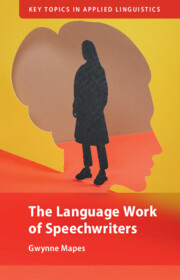
    The work of speechwriters is prominent in political discourse, yet the writers themselves remain in the shadows of the powerful, public figures they work for. This book throws the spotlight on these invisible wordsmiths, illuminating not only what they do, but also why it matters. Based on ethnographic research in the US American speechwriting community, it investigates the ways in which speechwriters talk about their professional practices, and also the material procedures which guide the production of their deliverables. Relying on a robust collection of various genres of discursive data, Mapes focuses on the primary rhetorical strategies which characterize speechwriters' discourse, neatly exposing how they are beholden to a linguistic marketplace entrenched in ideological and socioeconomic struggle. Providing fascinating insights into an understudied and relatively misunderstood profession, this book is essential reading for academic researchers and students in applied linguistics, discourse studies, linguistic and cultural anthropology, and sociolinguistics.

    Refine List

    Actions for selected content:

    Select all | Deselect all
    • View selected items
    • Export citations
    • Download PDF (zip)
    • Save to Kindle
    • Save to Dropbox
    • Save to Google Drive

    Save Search

    You can save your searches here and later view and run them again in "My saved searches".

    Please provide a title, maximum of 40 characters.
    ×

    Contents

    • 1 - Introduction
      pp 1-35
    • Wordsmiths and the Business of Rhetoric

    Metrics

    Full text views

    Total number of HTML views: 0
    Total number of PDF views: 0 *
    Loading metrics...

    Book summary page views

    Total views: 0 *
    Loading metrics...

    * Views captured on Cambridge Core between #date#. This data will be updated every 24 hours.

    Usage data cannot currently be displayed.

    Accessibility standard: WCAG 2.1 AA

    Why this information is here

    This section outlines the accessibility features of this content - including support for screen readers, full keyboard navigation and high-contrast display options. This may not be relevant for you.

    Accessibility Information

    The PDF of this book complies with version 2.1 of the Web Content Accessibility Guidelines (WCAG), covering newer accessibility requirements and improved user experiences and achieves the intermediate (AA) level of WCAG compliance, covering a wider range of accessibility requirements.

    Content Navigation
    Table of contents navigation

    Allows you to navigate directly to chapters, sections, or non‐text items through a linked table of contents, reducing the need for extensive scrolling.

    Index navigation

    Provides an interactive index, letting you go straight to where a term or subject appears in the text without manual searching.

    Reading Order and Textual Equivalents
    Single logical reading order

    You will encounter all content (including footnotes, captions, etc.) in a clear, sequential flow, making it easier to follow with assistive tools like screen readers.

    Short alternative textual descriptions

    You get concise descriptions (for images, charts, or media clips), ensuring you do not miss crucial information when visual or audio elements are not accessible.

    Visual Accessibility
    Use of colour is not sole means of conveying information

    You will still understand key ideas or prompts without relying solely on colour, which is especially helpful if you have colour vision deficiencies.

    Structural and Technical Features
    ARIA roles provided

    You gain clarity from ARIA (Accessible Rich Internet Applications) roles and attributes, as they help assistive technologies interpret how each part of the content functions.
