
Skip to main content Accessibility help
×
  • Cited by 4
    • Show more authors
    • You may already have access via personal or institutional login
    • Select format
    • Publisher:
      Cambridge University Press
      Publication date:
      February 2023
      February 2023
      ISBN:
      9781009199476
      9781009199490
      9781009199483
      Dimensions:
      (229 x 152 mm)
      Weight & Pages:
      0.47kg, 220 Pages
      Dimensions:
      (229 x 152 mm)
      Weight & Pages:
      0.303kg, 220 Pages
    You may already have access via personal or institutional login
  • Selected: Digital
    Add to cart View cart Buy from Cambridge.org

    Book description

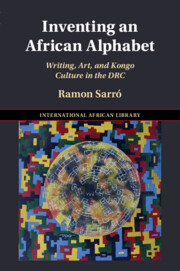
    In 1978, Congolese inventor David Wabeladio Payi (1958–2013) proposed a new writing system, called Mandombe. Since then, Mandombe has grown and now has thousands of learners in not only the Democratic Republic of Congo, but also France, Angola and many other countries. Drawing upon Ramon Sarró's personal friendship with Wabeladio, this book tells the story of Wabeladio, his alphabet and the creativity that both continue to inspire. A member of the Kimbanguist church, which began as an anticolonial movement in 1921, Wabeladio and his script were deeply influenced by spirituality and Kongo culture. Combining biography, art, and religion, Sarró explores a range of ideas, from the role of pilgrimage and landscape in Wabeladio's life, to the intricacies and logic of Mandombe. Sarró situates the creative individual within a rich context of anthropological, historical and philosophical scholarship, offering a new perspective on the relationships between imagination, innovation and revelation.

    Reviews

    ‘A truly fascinating book about a no less fascinating character and his inspired invention of an alphabet! Ramon Sarró explores in original ways the productive tensions between science, art and religion. In doing so, he offers us a brilliant reflection on the very process of human creativity.'

    Julien Bonhomme - École Normale Supérieure

    ‘Written with compassion, sincerity, and respect, Sarró privileges the voices of Wabeladio Payi and his Congolese interlocutors as the book deftly merges biography, reflection, and ethnography. This intriguing text will shape discussions of identity, religion, Kongo nationalism, and anthropological approaches to creativity and innovation for years to come.'

    Yolanda Covington-Ward - University of Pittsburgh

    ‘An authentic and significant work. It is ethnographically rooted, ethically correct, and scholarly tested. Sarro breathes new life into Kongo studies. The topic of this book, Mandombe, encapsulates thoughts about Kongo socio-cultural phenomena. A book for those interested in African ontology, history, and savoir-faire, particularly the Kongo.'

    Adrien N. Ngudiankama - President and Founder of Kongo Academy, Inc.

    ‘A multifaceted exploration of Kimbanguism, Kongo culture and expressions of identity, Sarro examines Wabeladio Payi's system of writing to explore human creativity and epistemology in a religious register. The evocative descriptions and lyrical prose that centre the enquiry around the relationship between Payi and Sarro make this an unusual and beautiful study.'

    Emma Wild-Wood - University of Edinburgh

    Refine List

    Actions for selected content:

    Select all | Deselect all
    • View selected items
    • Export citations
    • Download PDF (zip)
    • Save to Kindle
    • Save to Dropbox
    • Save to Google Drive

    Save Search

    You can save your searches here and later view and run them again in "My saved searches".

    Please provide a title, maximum of 40 characters.
    ×

    Contents

    Metrics

    Altmetric attention score

    Full text views

    Total number of HTML views: 0
    Total number of PDF views: 0 *
    Loading metrics...

    Book summary page views

    Total views: 0 *
    Loading metrics...

    * Views captured on Cambridge Core between #date#. This data will be updated every 24 hours.

    Usage data cannot currently be displayed.

    Accessibility standard: Unknown

    Why this information is here

    This section outlines the accessibility features of this content - including support for screen readers, full keyboard navigation and high-contrast display options. This may not be relevant for you.

    Accessibility Information

    Accessibility compliance for the PDF of this book is currently unknown and may be updated in the future.
