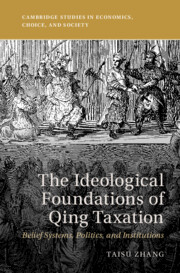

How states develop the capacity to tax is a question of fundamental importance to political science, legal theory, economics, sociology, and history. Increasingly, scholars believe that China's relative economic decline in the 18th and 19th centuries was related to its weak fiscal institutions and limited revenue. This book argues that this fiscal weakness was fundamentally ideological in nature. Belief systems created through a confluence of traditional political ethics and the trauma of dynastic change imposed unusually deep and powerful constraints on fiscal policymaking and institutions throughout the final 250 years of China's imperial history. Through the Qing example, this book combs through several interaction dynamics between state institutions and ideologies. The latter shapes the former, but the former can also significantly reinforce the political durability of the latter. In addition to its historical analysis of ideological politics, this book makes a major contribution to the longstanding debate on Sino-European divergence.
Co-winner, 2024 Allan Sharlin Memorial Book Award, Social Science History Association
‘A theoretically elegant, evidence-rich, and innovative explanation for why imperial China declined and fell. The Ideological Foundations of Qing Taxation sheds light on the roots of the ‘Great Divergence’ in economic development between China and Europe. A tremendous achievement that deserves to be widely read.’
Yuhua Wang - Professor of Government, Harvard University
‘This book is a brilliant new take on comparative economic history. Skillfully integrating institutional analysis, economics, and political thought, Zhang provides us with an erudite, deeply learned account of the Qing’s failure to expand tax capacity, drawing us into contemplation of a path not taken.’
Tom Ginsburg - Leo Spitz Distinguished Service Professor of International Law, University of Chicago
‘In this refreshing and incisive work, Taisu Zhang shows us how the weakness of the late Qing regime depended less on structural constraints than on a specific worldview about the proper role of the state. Low taxation was a deliberate choice, made in response to the presumed lessons of history, and it would have far-reaching implications. This will be of interest to anyone who wants to understand long trends in Chinese political development.’
David Stasavage - Julius Silver Professor, New York University
‘In this characteristically ambitious book, Taisu Zhang looks for obstacles on China’s path to modernization in a surprising place: tax capacity. He explains the unwillingness of China’s nineteenth-century rulers to raise taxes neither in terms of eternal cultural values nor structural factors, but rather as the outcome of a specific type of conservatism that can be explained historically.’
Michael Szonyi - Frank Wen-hsiung Wu Professor of Chinese History, Harvard University
‘Why did the Qing empire consistently under-tax its agricultural base? This book invites one to the backroom of emperors and statesmen as they debated fiscal policy, and performs a masterful dissection of the long-term ideological forces at work. A gripping read.’
He Bian - Associate Professor of History, Princeton University
‘… a compelling and nuanced exploration of the ideological and institutional forces that shaped Qing fiscal policy. … This book is a must-read for anyone interested in fiscal history, political economy, and intellectual history, as it not only deepens our understanding of Qing China but also offers important insights into the broader dynamics of statecraft and economic governance.’
Meng Zhang Source: Law and History Review
‘A compelling and original reinterpretation of Qing fiscal policy … Among the book’s most important contributions is its careful analysis of the ideological reasoning that sustained this restraint, along with the long-term consequences it carried for imperial governance. The result is a sophisticated and thought-provoking study with broad implications for our understanding of late imperial statecraft.’
Tristan Brown Source: H-Net: Humanities and Social Science Online
Loading metrics...
* Views captured on Cambridge Core between #date#. This data will be updated every 24 hours.
Usage data cannot currently be displayed.
This section outlines the accessibility features of this content - including support for screen readers, full keyboard navigation and high-contrast display options. This may not be relevant for you.
Accessibility compliance for the PDF of this book is currently unknown and may be updated in the future.
