
Skip to main content Accessibility help
×
  • Cited by 6
    • Show more authors
    • You may already have access via personal or institutional login
    • Select format
    • Publisher:
      Cambridge University Press
      Publication date:
      26 October 2023
      09 November 2023
      ISBN:
      9781009218979
      9781009218986
      9781009219006
      Dimensions:
      (229 x 152 mm)
      Weight & Pages:
      0.399kg, 174 Pages
      Dimensions:
      (229 x 152 mm)
      Weight & Pages:
      0.26kg, 174 Pages
    You may already have access via personal or institutional login
  • Selected: Digital
    Add to cart View cart Buy from Cambridge.org

    Book description

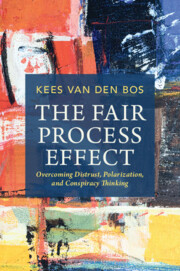
    The Fair Process Effect aims to shed light on why there are so many instances of distrust, polarization, and conspiracy thinking in our world and what we can do about this. The book focuses on the fair process effect as a mechanism that may help to start overcoming these important issues of societal discontent. This is a positive effect that people exhibit when they have been treated in genuinely fair and just ways by fellow human beings and societal authorities. Current insights presented in the book aid the understanding of why people may experience discontent, distrust, and disillusionment. Furthermore, these insights can be used to start countering exaggerated levels of distrust, heightened polarization, and unfounded conspiracy thinking. To this end, Van den Bos develops a coherent and modern account of the fair process effect, targeted at understanding and managing these pertinent issues.

    Reviews

    ‘As one of the world’s most important scientific contributors to the study of fair processes throughout his career, Kees van den Bos covers the literature comprehensively. In this book, he uses his encyclopedic knowledge to define and operationalize the research on perceived procedural justice as applied to societal discontent, polarization, conspiracy thinking, and the prevention of unwarranted distrust. It is an extraordinary accomplishment.’

    Robert Folger - University of Central Florida, USA

    ‘Brilliant! Written by one of the pre-eminent scholars in the field of social justice, this clear and cogent presentation of research, theory, and application of the fair process effect - a remarkably powerful social psychological phenomenon - is a ‘must read’ for social psychologists, sociologists, political scientists, legal scholars, and policy makers.’

    Allan Lind - Duke University, USA

    ‘Scholars and practitioners in management and law recognize the value of building rules and institutions around the psychological principles of the fair process effect. This deeply researched, compellingly written and engagingly optimistic book highlights the benefits of using this same model to address the political issues of polarization, distrust, and conspiracy thinking.’

    Tom Tyler - Yale University, USA

    ‘This book is timely, providing a comprehensive review of social psychological research on the topic and showcasing the practical applicability of research in addressing societal issues. This study is accessible to even novice readers, illustrating how research can contribute to solving social problems … Recommended.’

    S. Reysen Source: CHOICE

    Refine List

    Actions for selected content:

    Select all | Deselect all
    • View selected items
    • Export citations
    • Download PDF (zip)
    • Save to Kindle
    • Save to Dropbox
    • Save to Google Drive

    Save Search

    You can save your searches here and later view and run them again in "My saved searches".

    Please provide a title, maximum of 40 characters.
    ×

    Contents

    Metrics

    Full text views

    Total number of HTML views: 0
    Total number of PDF views: 0 *
    Loading metrics...

    Book summary page views

    Total views: 0 *
    Loading metrics...

    * Views captured on Cambridge Core between #date#. This data will be updated every 24 hours.

    Usage data cannot currently be displayed.

    Accessibility standard: Unknown

    Why this information is here

    This section outlines the accessibility features of this content - including support for screen readers, full keyboard navigation and high-contrast display options. This may not be relevant for you.

    Accessibility Information

    Accessibility compliance for the PDF of this book is currently unknown and may be updated in the future.
