
Skip to main content Accessibility help
×
  • Cited by 1
    • Show more authors
    • You may already have access via personal or institutional login
    • Select format
    • Publisher:
      Cambridge University Press
      Publication date:
      August 2023
      September 2023
      ISBN:
      9781009304276
      9781009304252
      9781009304245
      Dimensions:
      (229 x 152 mm)
      Weight & Pages:
      0.62kg, 334 Pages
      Dimensions:
      (229 x 152 mm)
      Weight & Pages:
      0.49kg, 334 Pages
    You may already have access via personal or institutional login
  • Selected: Digital
    Add to cart View cart Buy from Cambridge.org

    Book description

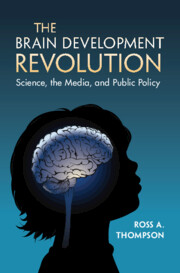
    The science of human development informs our thinking about children and their development. The Brain Development Revolution asks how and why has brain development become the major lens for understanding child development, and its consequences. It describes the 1997 I Am Your Child campaign that engaged public attention through a sophisticated media communications effort, a White House conference, and other events. It explores the campaign's impact, including voter initiatives to fund early childhood programs and a national campaign for prekindergarten education, but also several missed opportunities. The study examines why brain development compels our attention, why we are – but shouldn't be – neurodeterminists, and the challenges of communicating developmental brain science. This book examines the framing of the brain development story, the selectivity of the messaging, and overpromising the results of early programs. Lastly, it discusses proposals for how science communication can be improved to better serve children and the public.

    Reviews

    ‘If you’ve ever experienced awe at a picture of a brain lit up, or felt wonder at the smile on a baby’s face, you will benefit from reading this book. Ross Thompson provides the first authoritative story of the science, people, and events of the recent brain development revolution. Thompson gives us novel perspectives on the power of developmental neuroscience. He opens new vistas on the opportunities of parents, teachers, citizens, and scientists for helping every child flourish. This is a marvellous book.’

    Andrew N. Meltzoff - Co-Director, Institute for Learning and Brain Sciences, University of Washington, USA, and co-author, The Scientist in the Crib: Minds, Brains, and How Children Learn

    ‘The Brain Development Revolution provides a fascinating, insightful account of how brain science came to dominate early childhood policy debates - driven not by ‘the science,’ but by public messaging about that science, with successes, missed opportunities, and unintended negative consequences for early childhood policy. This important book illuminates the often obscured interplay between scientific knowledge, political priorities, and values in early childhood advocacy, and highlights the need for broader, more inclusive policy deliberations to advance better policy for young children.’

    Katharine B. Stevens - Founder and CEO, Center on Child and Family Policy, USA

    Refine List

    Actions for selected content:

    Select all | Deselect all
    • View selected items
    • Export citations
    • Download PDF (zip)
    • Save to Kindle
    • Save to Dropbox
    • Save to Google Drive

    Save Search

    You can save your searches here and later view and run them again in "My saved searches".

    Please provide a title, maximum of 40 characters.
    ×

    Contents

    Metrics

    Altmetric attention score

    Full text views

    Total number of HTML views: 0
    Total number of PDF views: 0 *
    Loading metrics...

    Book summary page views

    Total views: 0 *
    Loading metrics...

    * Views captured on Cambridge Core between #date#. This data will be updated every 24 hours.

    Usage data cannot currently be displayed.

    Accessibility standard: Unknown

    Why this information is here

    This section outlines the accessibility features of this content - including support for screen readers, full keyboard navigation and high-contrast display options. This may not be relevant for you.

    Accessibility Information

    Accessibility compliance for the PDF of this book is currently unknown and may be updated in the future.
